














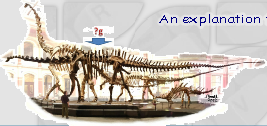
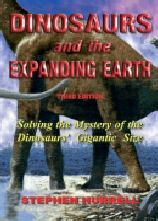
Many people have written complementary reviews after they enjoyed reading my book Dinosaurs and the Expanding Earth. It has been highlighted by scientists up to professor level, received positive reviews in magazines and praise from many readers.
Here are extracts and links to some of the most interesting:
Here are extracts and links to some of the most interesting:
-------------------000----------------–
Extract from Earth, Universe, Cosmos
by Professor S. Warren Carey
Mesozoic dinosaurs could not have existed with present surface gravity, nor would have bat-like pterosaurs with 12 metre wing spans. Engineers (Hurrell, 1994) have shown that dinosaurs’ bones could not have borne their weight ...
The size of dinosaurs peaked in the Jurassic with Diplodocus, Brontosaurus, and flying reptiles like Quetzalcoatlus. By the mid-Cretaceous Triceratops and Tyrannosaurus rex were much smaller, although still huge. Oligocene animals were much smaller although very much larger than their modern relatives. Birds became lighter from the heavy-boned Archaeopteryx and the bird-like Iguanodon to much lighter modern birds.
by Professor S. Warren Carey
Mesozoic dinosaurs could not have existed with present surface gravity, nor would have bat-
The size of dinosaurs peaked in the Jurassic with Diplodocus, Brontosaurus, and flying reptiles like Quetzalcoatlus. By the mid-
See extract from Earth Universe Cosmos here
With thanks to Professor S. Warren Carey for permission to reproduce this extract from Earth Universe Cosmos.
S. Warren Carey’s book available from University of Tasmania here
With thanks to Professor S. Warren Carey for permission to reproduce this extract from Earth Universe Cosmos.
S. Warren Carey’s book available from University of Tasmania here
-------------------000------------------
Annals Of Geophysics review of Dinosaurs and the Expanding Earth
by Professor Giancarlo Scalera
Have you seen the huge dinosaurs footprint in Colorado? Or in Australia? Have you looked critically at a dinosaur skeleton in a Paleontology Museum (If you visit the Cappellini Museum in Bologna)? The size, posture and estimated weight of these giants are impressive and the problem of the mechanical deambulation of such large bodies has been posed many times. ... Stephen Hurrell’s book Dinosaurs and the Expanding Earth ... offers a discussion of this problem, proposing an increasing gravity throughout geologic time. ... The book is written in a plain straightforward style ... Its clear and lively descriptions lead the reader straight to the core of the arguments.
Free pdf copy of full review here
-------------------000------------------
Personal communication
by Dr James Maxlow
(This) cleared up a very contentious issue for me ... I checked my mathematical modelling today and discovered ... surface gravity during the Permian was about 50% what it is today, precisely what you are suggesting.
Also Extract from: Terra Non Firma Earth
by Dr James Maxlow
It can be seen that on an Expanding Earth, surface gravity during the Precambrian Eras would be about one third of the present value and about one half of the present value during the Mesozoic Era. The Mesozoic Era of course was the Era of dinosaurs, those very large, very long bodied creatures who could very well have benefited from a much lower surface gravity.
... for an Earth undergoing expansion as a result of an increase in mass over time, the surface gravity during the Triassic Period would have been approximately 50 percent of the present value. This then increased to approximately 75 percent of the present value during the Late Cretaceous Period.
Considering the large size and length of many of the dinosaur species, this much reduced surface gravity would have benefited their existence and mobility immensely. The progressive increase in surface gravity over time may then offer an additional explanation for the relatively rapid turnover of dinosaur species throughout their long history.
Details of James Maxlow’s book, Terra Non Firma Earth, are on Amazon here
Also Extract from: On the Origin of Continents and Oceans
by Dr James Maxlow
Hurrell, in 1994, provided independent evidence for a reduced gravity during these time after analysing the mechanical aspects of dinosaur bones. He concluded that it would have been impossible for the larger dinosaurs to exist in environments of high surface gravity - such as exist now. From his mechanical studies of dinosaur bones Hurrell also independently calculated a surface gravity during Permian of 50 percent of the present surface gravity.
Details of James Maxlow’s book, On the Origin of Continents and Oceans, are on Amazon here
by Dr James Maxlow
It can be seen that on an Expanding Earth, surface gravity during the Precambrian Eras would be about one third of the present value and about one half of the present value during the Mesozoic Era. The Mesozoic Era of course was the Era of dinosaurs, those very large, very long bodied creatures who could very well have benefited from a much lower surface gravity.
... for an Earth undergoing expansion as a result of an increase in mass over time, the surface gravity during the Triassic Period would have been approximately 50 percent of the present value. This then increased to approximately 75 percent of the present value during the Late Cretaceous Period.
Considering the large size and length of many of the dinosaur species, this much reduced surface gravity would have benefited their existence and mobility immensely. The progressive increase in surface gravity over time may then offer an additional explanation for the relatively rapid turnover of dinosaur species throughout their long history.
Details of James Maxlow’s book, Terra Non Firma Earth, are on Amazon here
Also Extract from: On the Origin of Continents and Oceans
by Dr James Maxlow
Hurrell, in 1994, provided independent evidence for a reduced gravity during these time after analysing the mechanical aspects of dinosaur bones. He concluded that it would have been impossible for the larger dinosaurs to exist in environments of high surface gravity -
Details of James Maxlow’s book, On the Origin of Continents and Oceans, are on Amazon here
-------------------000----------------–
Extract from Reservoirs in Naturally Fractured
by Emeritus Professor Lance Endersbee in ATSE Focus
... the force of gravity may have been less in earlier times. Stephen Hurrell, a design engineer, worked out that the bones of the larger Dinosaurs were too weak to support their own body weight. He concluded that they could only have evolved at a time when the force of gravity at the Earth's surface was much less than at present. ... Like many such independent thinkers ... we can understand the huge size of the Dinosaurs.
-------------------000----------------–
Extract from The Growing Earth
by David de Hilster
One of the predictions of a growing earth where mass is increasing, is a reason why dinosaurs and other animals morphed into gigantism. Dragonflies with 2 foot wingspans, crustaceans the size of human beings – all of these can be explained by a smaller gravitational field. ... In a ground-
Book details -
-------------------000------------------
Geology Today Review
by unknown reviewer
Stephen Hurrell's Dinosaurs and the Expanding Earth is something completely different. Hurrell's thesis -
See full review here
With thanks to GEOLOGY TODAY - Blackwell Science Ltd, (here) for permission to reproduce this full review.
With thanks to GEOLOGY TODAY -
-------------------000------------------
Fortean Times Magazine Review
by Matt Salusbury
by Matt Salusbury
Very big and far away - Reduced gravity explains how pterosaurs could fly and dinosaurs run ...
If it's correct, mechanical design engineer Stephen Hurrell's idea (first put forward in the 1994 hardback edition) would be the biggest paradigm-shift since Copernicus announced the Earth moved round the Sun. Puzzled at how the hugest dinosaurs could support their own weight, Hurrell has concluded that gravity was less in the dinosaur days of the Mesozoic Era, and that our planet has been expanding in size. This has in turn increased the force of its gravity.
Read the full review here
With thanks to Fortean Times Magazine (here) for permission to reproduce this review in full.
If it's correct, mechanical design engineer Stephen Hurrell's idea (first put forward in the 1994 hardback edition) would be the biggest paradigm-
Read the full review here
With thanks to Fortean Times Magazine (here) for permission to reproduce this review in full.
-------------------000------------------
Amazon UK customer review for Dinosaurs and the Expanding Earth
by C. Kelly
Finally, a good explanation for why Tyrannosaurus rex was as scary as it looks
This book clearly explains the reason why dinosaurs were so successful for so long in spite of their giant sizes. Theories about carnivorous (and vicious looking!) dinosaurs being scavengers have been widely accepted by scientists because otherwise the giants would be far too big to move effectively about the planet. The author gives a much better explanation using concepts which elegantly apply to the scale of all land life, including birds, insects and plants over millions of years. ...
See full review here
by C. Kelly
Finally, a good explanation for why Tyrannosaurus rex was as scary as it looks
This book clearly explains the reason why dinosaurs were so successful for so long in spite of their giant sizes. Theories about carnivorous (and vicious looking!) dinosaurs being scavengers have been widely accepted by scientists because otherwise the giants would be far too big to move effectively about the planet. The author gives a much better explanation using concepts which elegantly apply to the scale of all land life, including birds, insects and plants over millions of years. ...
See full review here
-------------------000----------------–
Amazon US customer review for Dinosaurs and the Expanding Earth
by Don Findlay
... a milestone in palaeontology
In the fine tradition of cross-disciplinary investigation, Stephen Hurrell has put his finger on an answer to what is surely one of the most perplexing questions in palaeontology - why the dinosaurs were so huge, .. and why they died out, and links it to the most controversial of challenges to Earth science, namely the geological evidence that the Earth is getting bigger.
His exploration of the topic is a typical example of how someone new to a field and with often limited knowledge of it can, with incisive clarity, see fundamental connections that others cannot - or perhaps rather will not, because to do so creates ructions that cut right to the core of held beliefs of the field.
See full review here
by Don Findlay
... a milestone in palaeontology
In the fine tradition of cross-
His exploration of the topic is a typical example of how someone new to a field and with often limited knowledge of it can, with incisive clarity, see fundamental connections that others cannot -
See full review here
-------------------000----------------–
Amazon US customer review for Dinosaurs and the Expanding Earth
by William Erickson
A Landmark Book
Stephen Hurrell has written a landmark book that will still be read and cited 100 years from now. Although others before Hurrell had postulated that dinosaurs evolved in reduced surface gravity, i.e. less than it is today, Hurrell's book is the first to fully develop the argument. Hurrell is an engineer by profession, and he applies the principles of engineering to the problem of dinosaur gigantism and shows how and why dinosaurs must have evolved in reduced gravity. ...
See full review here
by William Erickson
A Landmark Book
Stephen Hurrell has written a landmark book that will still be read and cited 100 years from now. Although others before Hurrell had postulated that dinosaurs evolved in reduced surface gravity, i.e. less than it is today, Hurrell's book is the first to fully develop the argument. Hurrell is an engineer by profession, and he applies the principles of engineering to the problem of dinosaur gigantism and shows how and why dinosaurs must have evolved in reduced gravity. ...
See full review here
-------------------000------------------
Amazon customer review for Dinosaurs and the Expanding Earth
by unknown reviewer
Important trailblazing work
This book touches upon what is today considered forbidden scientific territory, ... this wonderful text is the best we have. I hope it brings forth the second generation of researchers this subject area so desperately needs.
See full review here
by unknown reviewer
Important trailblazing work
This book touches upon what is today considered forbidden scientific territory, ... this wonderful text is the best we have. I hope it brings forth the second generation of researchers this subject area so desperately needs.
See full review here
-------------------000----------------–
Amazon UK customer review for Dinosaurs and the Expanding Earth
by Dom
A wide ranging book
... it is a very convincing look at the evidence for expanding earth. ...
Don't let the title mislead you into believing this book has a narrow focus, this is a very wide ranging thorough analysis of expanding earth theory! ...
See full review here
-------------------000----------------–
Google Books review for Dinosaurs and the Expanding Earth
by David de Hilster
This book is the first of its kind to take on the subject from a global perspective. The Earth and other celestial bodies are indeed growing and this books adds another dimension of evidence. And if you don't know much about the history of the expanding or growing earth, this book gives a decent history of the subject. Hurrell is right on and finally gives compelling universal answers as to why giants existed back "then" and not "now".
by David de Hilster
This book is the first of its kind to take on the subject from a global perspective. The Earth and other celestial bodies are indeed growing and this books adds another dimension of evidence. And if you don't know much about the history of the expanding or growing earth, this book gives a decent history of the subject. Hurrell is right on and finally gives compelling universal answers as to why giants existed back "then" and not "now".
-------------------000------------------
Personal communication
by Edwin Myers - Film maker
I thought I was the only one who questioned the riddle of Dinosaur size. (This) book is fascinating ... I'm pleased and at the same time a little envious. I could never have written a better study of this phenomenon.
by Edwin Myers -
I thought I was the only one who questioned the riddle of Dinosaur size. (This) book is fascinating ... I'm pleased and at the same time a little envious. I could never have written a better study of this phenomenon.
-------------------000----------------–
By Dennis on Goodreads
I think that traditional science has some explaining to do:
I think that traditional science has some explaining to do:
There are basically two levels of theories introduced in this book.
The primary one is the Reduced Gravity Theory [RGT]. This postulates that the Earth had to exert less gravity in the past compared to today in order for pre-historic lifeforms (not just Dinosaurs but giant centipedes, dragonflies, etc.) to evolve to the size limits that they had. Not only that, but this book shows graphically how the upper limit to the size of Earth's complex lifeforms has dropped linearly over time.
Once one accepts RGT -- and it becomes pretty difficult to not do so -- then one asks, "OK...then WHY did Earth's gravity increase and is still (theoretically) increasing?"
-------------------000----------------–
We need challengers like this!
Thanks, Stephen Hurrell for a new angle of approach! The conventional theories always seem to have large holes that everyone is happy to excuse...
-------------------000----------------–
A Small Book that Packs a Giant Punch
Hurrell’s theory, argued very persuasively, is that the Earth was smaller and hence gravity was less in the distant past. Many different sets of data fit with his argument – including the fact that in every era since the extinction of the dinosaurs the biggest land animals have been progressively smaller. The super-giant land mammals of 35-40 million years ago for example grew much larger than their counterparts today. A graphic illustration of the size difference between the largest dinosaurs and today’s largest land animals...
See full review here
See full review here
-------------------000----------------–
Comment on this web page here
Related Page
|
|
Updated 18Aug15

“Stephen Hurrell’s book
(proposes) an increasing gravity throughout geologic time. Its clear and lively descriptions lead the reader straight to the core of the arguments”
Professor Giancarlo Scalera
(proposes) an increasing gravity throughout geologic time. Its clear and lively descriptions lead the reader straight to the core of the arguments”
Professor Giancarlo Scalera
“Hurrell [has] shown dinosaurs’ bones could not have borne their weight”
Professor S. Warren Carey
Professor S. Warren Carey
“surface gravity during the Permian was ... precisely what you are suggesting ... much reduced surface gravity would have benefited their existence and mobility immensely”
Dr James Maxlow
Dr James Maxlow
“Like many such independent thinkers ... we can understand the huge size of the Dinosaurs”
Professor Lance Endersbee
Professor Lance Endersbee

“In a ground-breaking book, Stephen Hurrell deduces the gravity constant from the sizes of gigantic animals”
David de Hilster
David de Hilster
“...the biggest paradigm-shift since Copernicus announced the Earth moved round the Sun.”
Matt Salusbury
Matt Salusbury
“...this is an original work rather than a re-presentation of existing knowledge...”
Geology Today
Geology Today
“This book clearly explains the reason why dinosaurs were so successful for so long in spite of their giant sizes”
C. Kelly
C. Kelly
“Stephen Hurrell has put his finger on an answer to what is surely one of the most perplexing questions in palaeontology - why the dinosaurs were so huge”
Don Findlay
Don Findlay
“Stephen Hurrell has written a landmark book that will still be read and cited 100 years from now”
William Erickson
William Erickson
“This book touches upon what is today considered forbidden scientific territory...”
“... it is a very convincing look at the evidence...”
Dom
Dom
“...finally gives compelling universal answers as to why giants existed back "then" and not "now".”
David de Hilster
David de Hilster
“(This) book is fascinating...”
Edwin Myers
Edwin Myers
“traditional science has some explaining to do”
Dennis
Dennis