















Share this page
A palaeogravity calculation for the gigantic fossil arthropod
Hibbertopterus (Eurypterida)
by
Stephen W. Hurrell
Hibbertopterus (Eurypterida)
by
Stephen W. Hurrell
Abstract
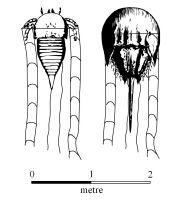
One fundamental technique to quantify palaeogravity is to compare dynamically similar extinct and extant animals. This technique is applied to a fossil trackway of the gigantic fossil arthropod Hibbertopterus (Eurypterida). The results indicate a tentative palaeogravity of about 0.37g for 330 Ma.
Suggested Citing Format
Hurrell, S.W. (2021). A palaeogravity calculation for the gigantic fossil arthropod Hibbertopterus (Eurypterida).
https://www.dinox.org/publications/Hurrell2021a.pdf
https://www.dinox.org/publications/Hurrell2021a.pdf
Page updated 08 Sept 2026
Wayback
Wayback
Comments
Facebook - Bill Erickson. It was amphibious.
Palaeogravity Laboratory - dinox.org. Yes, they were both amphibious. We have discussed several times before why Dynamic Similarity doesn’t work when animals are supported by the buoyancy effect of water. But my Dynamic Similarity calculation here assumes that both animals used in the comparison were walking on land. The horseshoe crab definitely comes onto land because we can observe it doing exactly that. It is less certain that Hibbertopterus came onto land but several palaeontologists have argued that it did so based on its fossil footprints. The palaeontologists arguing against that seem to think it was too large to walk on land (in a 1g environment of course). So my Dynamic Similarity calculation must assume both animals were walking on land.
I’ve used a similar argument to calculate palaeogravity for the giant turtles and crocodiles in the Cretaceous but in their case they need to come onto land to lay their eggs.
Bill Erickson. I understand, but I still doubt that it's possible to calculate surface g from the skeletons of semiaquatic animals. For example, horse shoe crabs certainly can walk on dry land for brief stretches but their limbs need not support them 100% of the time, even when they're on dry land. They can simply pull in their legs and rest under their big carapace, which would provide structural support.